Where to Recycle Electronics in Dubai: Devices, Batteries & Drop-Offs
Choose the right Dubai recycling route for phones, laptops, cables, batteries, appliances, and business electronics—and prepare each item before handover.
Match the route to the device, condition, battery type, quantity, and whether the material comes from a home or business.
Dubai Municipality lists 13 Recycle Centres, but accepted streams can vary; check the selected location or call 800900 before travelling.
Remove accounts, SIM cards, and memory cards and complete any required data backup or destruction before handing over a device.
Keep batteries separate, protect exposed terminals, and ask for specialist instructions if a battery is swollen, hot, leaking, or damaged.
For large appliances or business quantities, confirm collection access and request documentation from an authorised recycling route.
Where to recycle electronics in Dubai
To recycle electronics in Dubai, use a current Dubai Municipality Recycle Centre, a verified retailer take-back programme, or an authorised e-waste collector suited to the item and quantity. Prepare personal data first, keep batteries separate, and confirm the location accepts your exact device before making the trip—especially for large appliances or damaged batteries.
The correct route depends on more than whether an item has a plug. A working phone may be suitable for reuse after a secure reset, while a broken television needs a collection route sized for its screen and weight. Office computers and larger business batches may also need inventory, data-destruction, and transfer records that a household drop-off does not provide.
Check before you travel
The centre list below was checked on 16 September 2026. Opening conditions and accepted materials can change, so confirm the selected centre and waste stream on the official Dubai Municipality page or through 800900 before loading your vehicle.
Choose a route for the device and its condition
Test only devices that are safe to power on. Do not charge, open, compress, or attempt to repair a battery that is swollen, unusually hot, leaking, damaged, or producing an odour. Isolate it from ordinary recyclables and obtain current instructions from Dubai Municipality or a qualified specialist.
Practical electronics recycling routes
Item or condition
Likely route
Prepare before handover
Working phone, tablet, or laptop
Verified reuse, trade-in, or an e-waste route
Back up, sign out, remove SIM or memory card, and securely erase data
Dead small electronics and cables
Confirmed Recycle Centre, take-back point, or authorised collector
Keep dry, group accessories, and avoid dismantling components
Loose dry-cell batteries
A location that specifically confirms battery acceptance
Separate by type and protect exposed terminals against contact
Large television or appliance
Retailer take-back or pre-arranged e-waste collection
Share dimensions, weight estimate, access, and whether dismantling is required
Office computers or a bulk batch
Authorised commercial e-waste processor
Create an asset list and agree data and transfer documentation in advance
Current Dubai Municipality Recycle Centres
Dubai Municipality's current help page lists Recycle Centres at Mirdif Park, Quranic Park, Al Rashidiya Park, Nadd Al Hamar Park, Hatta Centre, Al Karama Park, Al Satwa Park, Al Manara Centre, Umm Suqaim Park, Al Barsha 2 Pond Park, Al Tawar Centre, Muhaisnah 1 Park, and Al Nahda 2 Pond Park.
That list identifies locations, not a guarantee that every centre will accept every electronic item at the time you arrive. Check the map and current information on the official page, then confirm your device category, size, battery condition, hours, and any quantity limit. Dubai Municipality's published material also identifies discarded electronic devices, used phones, and dry batteries among recyclable streams collected through its facilities.
Choose the centre that you can reach without leaving electronics unattended in a vehicle or public area.
Ask separately about loose batteries, lamps, printer consumables, large screens, and appliances.
Keep the device inside your control until the receiving point confirms the handover.
If a listed point cannot take the item, ask for the current approved alternative rather than placing it beside a bin.
Prepare phones, computers, and batteries
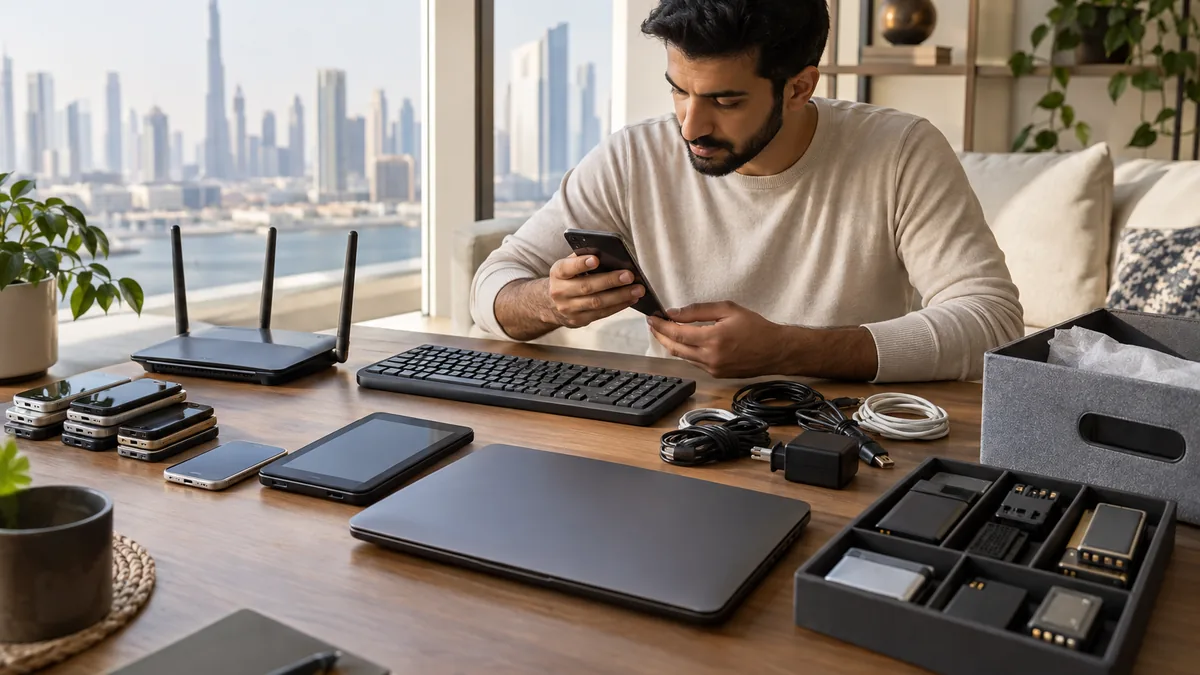
Complete backups and account transfers while the device still works. Sign out of manufacturer and cloud accounts, disable activation locks, remove SIM and memory cards, and use the manufacturer's supported erase process. For a device containing sensitive or business data, agree the required destruction or erasure evidence before collection rather than assuming recycling automatically proves data was destroyed.
Pack screens so they cannot flex or strike other items, and keep cables tidy without tying them around fragile equipment. Separate removable batteries where the manufacturer permits it; do not force open a sealed device. Cover exposed terminals on loose batteries with non-conductive tape and prevent batteries from moving against metal objects during transport.
At the drop-off, keep streams separated
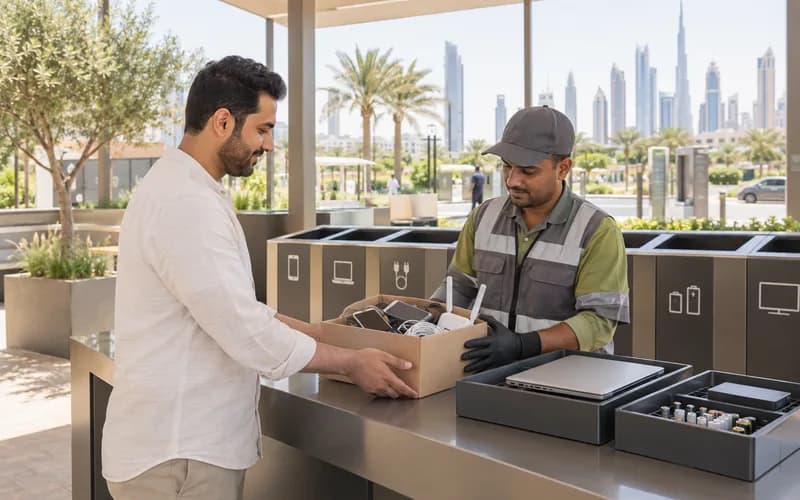
Follow the signs and staff instructions at the selected facility. Hand over devices, accessories, and accepted batteries in their correct streams rather than tipping one mixed box into the first opening. If an item is refused, take it away and verify another route; never leave it on the ground or beside a collection container.
Record the location and date if you need a household receipt. For a business batch, use the agreed asset list and count items at transfer. A clean handover protects devices from breakage, keeps batteries out of unsuitable loads, and makes it easier for the receiving operator to route reusable equipment and recyclable material correctly.
Confirm acceptance first, then keep devices, accessories, and batteries in the streams specified by the receiving facility.
Arrange collection for appliances and larger batches
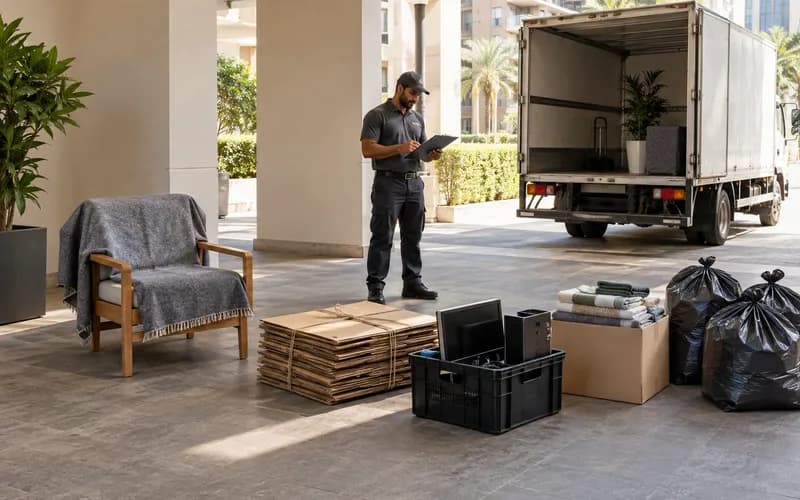
A refrigerator, washing machine, large television, server cabinet, or office clear-out needs more planning than a bag of cables. Share an itemised photo set, dimensions, approximate quantity, floor, lift or stair access, loading distance, and building requirements. Ask whether the crew accepts the exact equipment and how batteries, refrigerants, screens, or storage media will be handled.
Businesses should verify the provider and agree what documentation will be supplied, particularly when devices contain company data or asset tags. For a mixed household electronics load, Dubai Junk Collection can scope the access and collection route after reviewing photos and item details; restricted or damaged batteries may still require a separate specialist.
Can I recycle charging cables and adapters in Dubai?
Many e-waste routes accept cables and adapters, but confirm the specific drop-off or collector first. Keep them dry, untangled, and separate from loose batteries. If an adapter is damaged, do not plug it in to test it; show the receiving party its condition before handover.
Where should printer cartridges go?
Printer cartridges are often handled through manufacturer, retailer, or specialist return programmes rather than a general electronics container. Keep the cartridge sealed to prevent toner or ink leakage, check the brand's current take-back route, and ask Dubai Municipality for a current alternative if no programme is available.
Can a broken smart television be recycled?
It may be accepted by a large-item e-waste collector or retailer take-back service, but confirm before moving it. Protect a cracked screen, do not dismantle the unit, and share its size, floor, lift, and loading access. Two-person handling or specialist equipment may be required for a large screen.
What should I do with old CDs, DVDs, and data tapes?
Do not assume they belong in an electronics container. Ask the selected facility whether it accepts that media type. If the media contains confidential information, use an appropriate secure-destruction service and agree the evidence required before surrendering it for material recovery or disposal.
Planning a clearance in Dubai?
Send photos of what you need cleared on WhatsApp. Our team provides an instant, fixed upfront rate and handles elevator bookings and gate security smoothly.
Tags:#Where to Recycle Electronics in Dubai#E-Waste Recycling Centres Dubai#Electronics Disposal Dubai#Battery Recycling Dubai
Dubai Junk Collection Editorial Team
Operations & Pricing Specialists
Specialists in residential and commercial clearances across Dubai since 2016. Committed to safe property handovers, compliant electronic waste disposal, and municipal green waste diversion.
 Ask a Question