How to Dispose of Old Kitchen Cabinets in Dubai: Approvals, Worktops and Reusable Units
An old kitchen comes out in a strict order: approvals, isolation, doors, worktops, wall units, then base units. Get the order right and much of it can be reused rather than skipped.
In a rented home the kitchen normally belongs to the landlord; get written approval before anything is removed.
Water, gas and electrical connections must be isolated by competent people before cabinets come off the wall.
Never dry-cut a quartz or engineered-stone worktop; remove it whole or leave cutting to a contractor with dust controls.
Intact, recent cabinet runs can be sold as a set; water-damaged boards and offcuts go with renovation waste.
How do you dispose of old kitchen cabinets in Dubai?
Confirm you own the kitchen and have landlord and building approval, then have the water, gas and electrics isolated by competent people. Empty the units, remove doors and worktops first, and separate reusable cabinet runs from water-damaged boards, stone offcuts and metal fittings before booking a collection that allows for their weight.
Working out how to dispose of old kitchen cabinets in Dubai starts before anything is unscrewed, because a fitted kitchen is part of the property rather than loose furniture. It is plumbed, wired and often gas-connected, and the building usually has a view on when and how renovation work happens inside it.
Settle ownership and approvals first
In a rented apartment or villa, the kitchen almost always belongs to the landlord. Dubai's tenancy rules require a tenant to obtain the landlord's approval, and any permits the authorities require, before making alterations. Get that consent in writing, and agree who pays to reinstate or replace the kitchen, before a single door comes off. Removing a landlord's kitchen without it is a fast route to a deposit dispute.
Owners have a different checklist. Most towers and master communities ask for a renovation notification or NOC, contractor details, working hours and lift protection before fit-out work starts. Kitchen removal is noisy and dusty, and the building will expect debris to leave through the service lift during an approved window, not through the passenger lobby.
Take the kitchen out in the right order
Isolate first. Close the water valves under the sink and disconnect the taps and waste; have the gas supply capped by the provider or a qualified technician; and have an electrician make the cooker circuit and any under-cabinet lighting safe. Then take out the built-in appliances before the cabinets that hold them lose their strength.
From there the sequence is simple but matters. Doors and drawer fronts come off first, which makes carcasses lighter and protects the fronts if they are going to be reused. Worktops come next, then wall units, then base units, plinths and cornice. Wall units hang on brackets or rails and need two people: one to support the cabinet and one to release the fixings.
Never dry-cut a quartz or stone worktop
Cutting engineered stone releases respirable crystalline silica, which can cause serious lung disease. The UK Health and Safety Executive treats dry cutting of engineered stone as unacceptable. Lift the worktop out whole, or leave any cutting to a contractor with water suppression and proper respiratory protection.
Empty every cupboard and clear the tops of wall units before work begins.
Remove handles and soft-close hinges and keep them in a labelled box for resale or metal recovery.
Cut silicone along the worktop and splashback with a blade before lifting, so tiles and wall finish are not pulled away.
Carry stone worktops on edge, never flat, supported along their length.
Separate what can be reused from what cannot
Cabinets from a kitchen fitted in the last few years often have a second life in a garage, laundry room, storeroom or a smaller flat. They sell best as a complete run with measurements of each unit, clear photographs, and hinges and handles included. Kitchens with swollen board under the sink, sagging shelves or dated doors on worn carcasses are unlikely to find a buyer.
What remains is renovation waste and should be treated as such. Dubai Municipality's duty-of-care guidance makes the waste producer responsible for passing waste to an authorised carrier, so check that whoever takes the debris away is licensed to move it and will deliver it to an approved facility.
Where each part of an old kitchen usually goes
Component
Reuse chance
Preparation
Intact carcasses and doors from a recent kitchen
Good when sold as a complete run
Keep units whole, list dimensions and include hinges and handles
Water-damaged sink base or swollen board
None
Break down and bag with renovation waste
Granite, marble or quartz worktop
Occasional, as offcuts for smaller projects
Remove whole, carry on edge and declare size and weight
Laminate worktop
Low
Remove fixings and treat as timber-based waste
Sink, taps, hinges, runners and handles
Good for metal recovery
Separate into a box so they are not lost in mixed debris
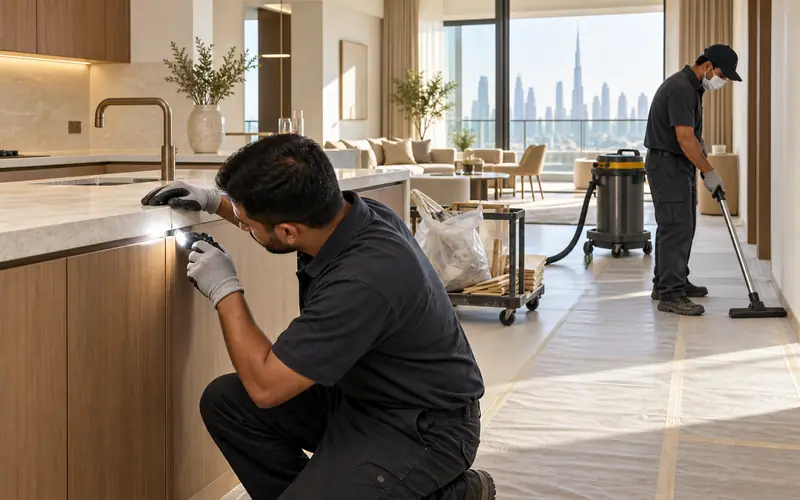
Checking carcasses for water damage and loose fixings before removal shows which units can be reused and which belong in the debris load.
Plan the carry-out as well as the removal
A single kitchen produces more volume than most people expect: carcasses, doors, plinths, worktops, packaging from the new units and bags of silicone, screws and plaster. In a tower, book the service lift for the full job, keep corner guards and floor runners in place until the last worktop is out, and let the security desk know when debris will pass through the loading bay.
Send the collector photographs of the kitchen, the worktop material and length, the floor and lift details, and whether anything is being kept for resale. That lets the crew bring enough people for the stone and the right transport for the load in one visit, instead of leaving half a kitchen in the corridor overnight.
What happens to the wall once the old cabinets are removed?
Expect plug holes, bracket marks and sometimes unpainted or untiled strips where the units sat. If you are a tenant returning the property, agree with the landlord whether you must patch and paint before handover. If a new kitchen is going in, the fitter will usually prepare the wall as part of installation.
Can old kitchen cabinets go in the community bins?
No. Cabinets, worktops and fitting debris are renovation waste, not household rubbish, and community bins are not sized or permitted for them. Keep them inside the property until an authorised collector takes them away, and never leave boards or stone in a corridor, car park or on the verge outside a villa.
Can I keep the cabinets and only replace the doors?
Often, yes, if the carcasses are square, dry and firmly fixed. Replacing doors, drawer fronts and handles is a common way to refresh a sound kitchen. It only works when the hinge positions match the new doors, so check measurements before ordering and dispose of just the old fronts.
Planning a clearance in Dubai?
Send photos of what you need cleared on WhatsApp. Our team provides an instant, fixed upfront rate and handles elevator bookings and gate security smoothly.
Specialists in residential and commercial clearances across Dubai since 2016. Committed to safe property handovers, compliant electronic waste disposal, and municipal green waste diversion.
 Ask a Question