Hazardous Waste Disposal Dubai: A Safe Household Guide
Identify household material that needs a specialist route, keep it sealed and separated, and verify an approved Dubai collection option before moving it.
Do not pour, burn, puncture, mix, or place suspected hazardous material in an ordinary household or junk-removal load.
Keep products in sound original containers where possible, upright and sealed, with labels visible and incompatible materials separated.
Use Dubai Municipality's current guidance and approved-company information to verify the route before booking transport.
Treat leaking, heating, fuming, bulging, or unidentified material as a stop signal and seek specialist or emergency direction without handling it further.
A normal clearance crew can remove the non-hazardous remainder after restricted material has been identified and routed separately.
Handle hazardous waste disposal in Dubai with three steps
For hazardous waste disposal in Dubai, stop ordinary clearing, keep the material sealed and separate, and verify the route with Dubai Municipality or an approved specialist. Do not mix chemicals, pour liquids away, puncture aerosols, or hide restricted material in a general load. The product, condition, quantity, and source determine who can transport it.
Household cupboards can contain paints, solvents, oils, pesticides, concentrated cleaners, batteries, aerosols, and unidentified containers that need more care than ordinary rubbish. You do not need to identify every chemical yourself. Preserve the label, avoid opening or testing it, photograph the container from a safe position, and describe what you know when requesting instructions.
Stop if the material is unstable
If a container is leaking, hot, swollen, fuming, badly corroded, or giving off a strong unknown odour, keep people away and do not move it. Contact building management and the appropriate specialist or emergency service for situation-specific instructions.
Which household items may need a specialist route?
A familiar retail product is not automatically suitable for a general bin once it is unwanted. Read the original label and safety warnings without opening the container. When the identity or condition is uncertain, describe it as unknown rather than guessing; a wrong label can expose the collector and receiving facility to an incompatible material.
Household materials to separate for route confirmation
Keep different fluids in separate compatible containers
Pressurised products
Aerosols, camping gas, cylinders, extinguishers
Do not puncture, vent, crush, or expose to heat
Batteries
Lead-acid, lithium, damaged rechargeable packs
Prevent terminal contact and report swelling, heat, or damage
Pesticides and concentrated cleaners
Pool chemicals, insecticides, acids, strong alkalis
Do not combine products or transfer them into drink bottles
Unknown or unlabelled material
Old workshop jars, powders, residues, corroded cans
Do not smell, test, open, or guess the contents
Stop, separate, and verify before collection
First, stop adding material to the general clearance pile. Second, separate each known product in its closed container without combining substances. Third, verify the current route by sharing the product name, label, condition, approximate quantity, property type, and access details with Dubai Municipality or a provider authorised for that waste type.
Ask the provider to confirm acceptance in writing and state who will collect, how the material should be presented, and what documentation applies. Never place containers in a corridor, loading bay, pavement, desert area, drain, or beside communal bins while waiting. Keep them under the property holder's control until the confirmed party takes possession.
Photograph labels without opening or cleaning a damaged container.
List each product and quantity instead of describing the job only as mixed chemicals.
Confirm whether packaging or secondary containment must be supplied by the specialist.
Recheck the provider's approval because waste categories and company status can change.
Store material temporarily without creating a new risk
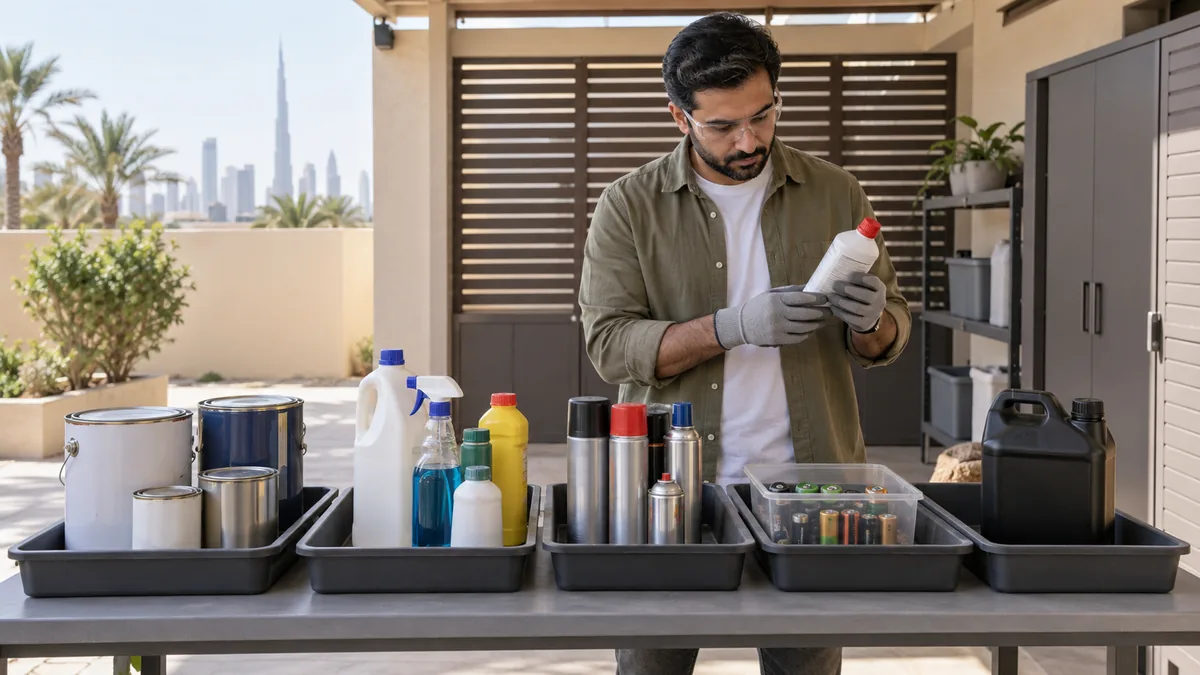
Until you receive instructions, leave sound products in their original compatible containers with caps closed and labels readable. Keep containers upright in separate stable trays or other suitable secondary containment, in a secure shaded area away from children, pets, food, drains, ignition sources, and vehicle traffic. Follow the manufacturer's storage instructions where they remain available.
Do not put incompatible materials into the same tray merely to make one compact box, and do not repackage chemicals into unlabelled jars or beverage bottles. Avoid prolonged storage: verification and prompt specialist collection are safer than building a permanent household chemical cupboard. If the container itself is failing, do not improvise a transfer; ask the specialist how it must be overpacked.
Use Dubai's current official framework
Dubai Municipality publishes waste technical guidelines and current circulars through its Waste Department pages. Its November 2025 hazardous-waste guideline requires suitable leak-free containers, prohibits mixing incompatible wastes, and directs hazardous material through approved transport and disposal routes. The official approved-company information should be checked at the time of booking rather than copied from an old list.
Dubai Municipality's RASID system is designed to register and monitor waste-management companies and vehicles. Use official contact channels when the waste category or provider status is unclear. A logo, social profile, or promise of general junk collection is not evidence that a company is authorised to handle a particular hazardous material.
Keep specialist material out of the general clearance
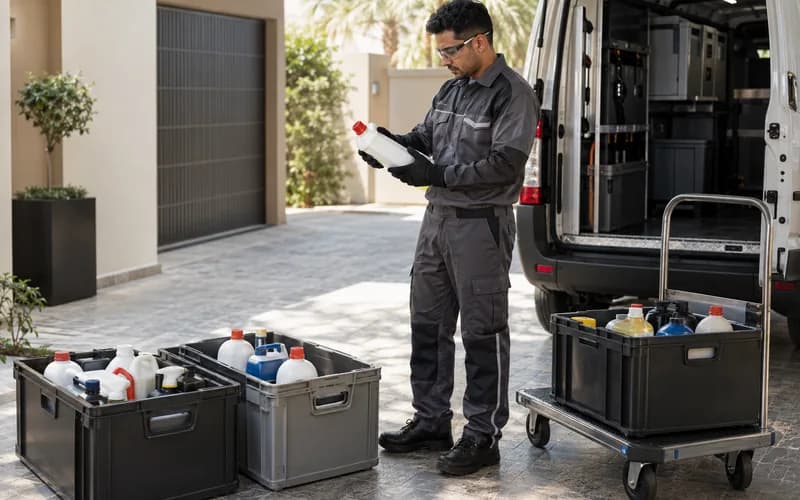
Tell every person working on the property which area is restricted and which items must not be loaded. The specialist should collect the confirmed hazardous material using the agreed containers, equipment, vehicle, and records. Do not ask a normal moving or junk crew to make a disposal decision at the door or to transport an undeclared container.
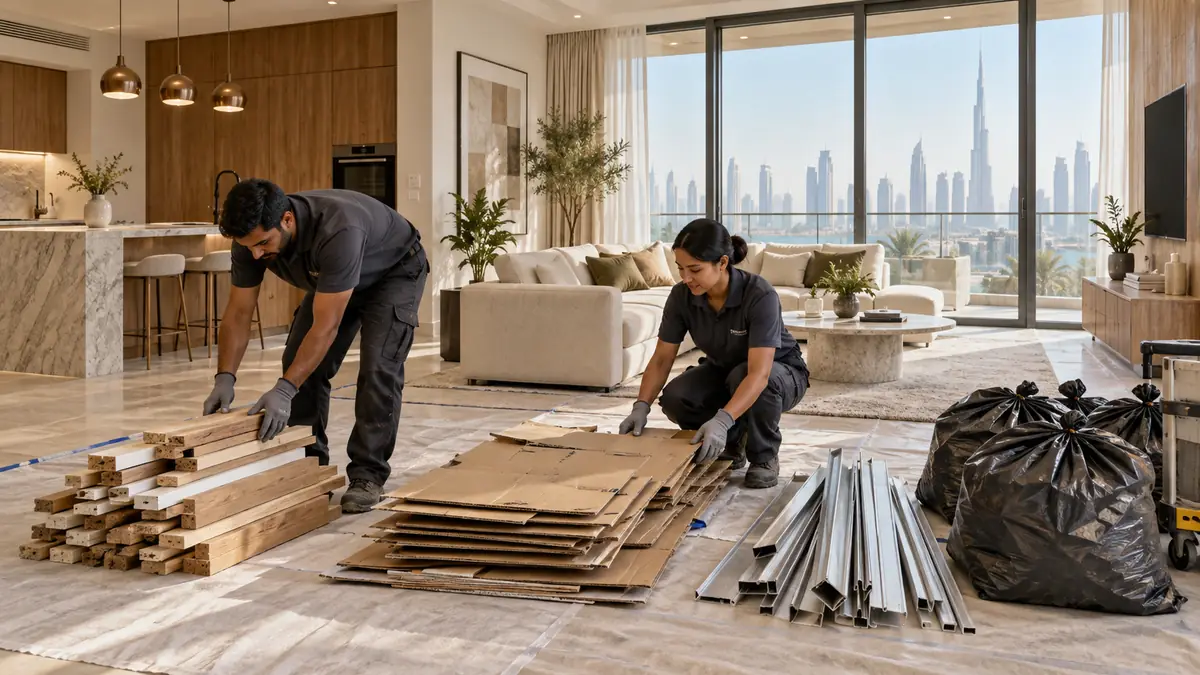
Once the restricted material has been removed or secured under specialist instructions, a general crew can scope ordinary furniture, cartons, household items, and other accepted contents separately. Dubai Junk Collection can review photos of that non-hazardous remainder and provide a clear service scope, while excluded material stays with its approved route.
A specialist collection begins with declared contents, secure containers, and a route approved for the material—not an ordinary mixed load.
Can an empty chemical or paint container go into normal recycling?
Do not assume that visually empty means residue-free or recyclable. Follow the product label and ask the receiving facility whether it accepts that exact container and residue type. Do not rinse chemical residue into a sink or drain, burn the container, or mix its contents with another product to empty it.
How should fluorescent tubes and lamps be discarded?
Keep them intact, dry, and protected from impact, and confirm a lamp or hazardous-material route before transport. Do not break a tube to fit a bin or box. If one is already broken, keep people away from the area and obtain current clean-up and collection instructions rather than sweeping it into ordinary rubbish.
Do medicines and medical sharps use the same route?
They require healthcare-specific advice, not an ordinary household chemical or junk collection. Keep medicines in their original packaging and sharps in an appropriate puncture-resistant container without recapping or handling loose needles. Contact the relevant healthcare provider, pharmacy, or authority for the current approved return route.
Can a small business use a household hazardous-waste option?
Do not rely on a household route for commercial waste. Business material may require classification, a Waste Disposal Service application, an approved transporter, and formal records based on the waste and activity. Use Dubai Municipality's current Waste Department guidance and verify the provider for the exact category and quantity.
Planning a clearance in Dubai?
Send photos of what you need cleared on WhatsApp. Our team provides an instant, fixed upfront rate and handles elevator bookings and gate security smoothly.
Specialists in residential and commercial clearances across Dubai since 2016. Committed to safe property handovers, compliant electronic waste disposal, and municipal green waste diversion.
 Ask a Question